

Why Is a Construction Recruitment Agency Better Than Direct Hiring?
A construction recruitment agency fills roles through a specialist third party; direct hire means your firm runs the process and brings the worker straight onto your payroll. Getting the right person on site fast determines whether a project finishes on time or haemorrhages money through delays. Construction recruitment agencies specialise in exactly this: connecting building firms with vetted, qualified workers across temporary, contract, and permanent roles without the administrative weight falling on the employer. They bring speed, compliance cover, and access to candidates who never appear on job boards, but the fees and reduced screening control are real trade-offs.
Direct hiring puts the employer in charge of every stage, from the job advert to the offer, which brings cost savings and stronger cultural fit at the expense of time and internal expertise most construction firms simply do not have spare. Knowing which route fits which vacancy is what separates a smooth project from a costly one.
What is a construction recruitment agency?
A construction recruitment agency is a specialist firm that connects construction businesses with skilled workers across temporary, contract, and permanent roles. It sources, vets, and places candidates from on-site tradespeople and plant operators to project managers handling compliance checks, certification verification, and right-to-work documentation on the employer’s behalf.
How a construction recruitment agency works
Understanding the process end-to-end helps employers set realistic expectations and get more from the relationship.
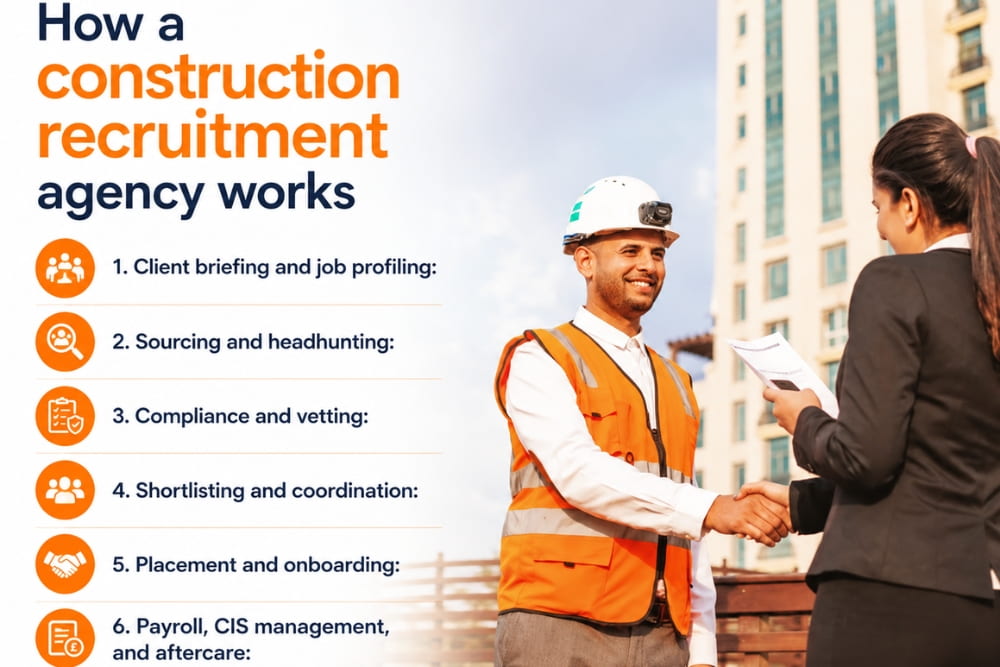
- Client briefing and job profiling: The agency and hiring manager define the role together, covering certifications, contract type, pay rate, start date, and site-specific requirements before any sourcing begins.
- Sourcing and headhunting: The agency searches its pre-vetted database first, then advertises on construction-specific job boards and directly approaches experienced workers who are employed and not actively searching.
- Compliance and vetting: Before presenting any candidate, the recruiter verifies identity, right-to-work status, CSCS card level, trade certifications, health and safety tickets, and CIS subcontractor status where applicable.
- Shortlisting and coordination: A curated shortlist of two to four candidates is presented with compliance summaries and availability confirmed. The consultant handles interview scheduling, feedback, and rate or salary negotiation.
- Placement and onboarding: Once a candidate is selected, the agency manages offer paperwork and first-day logistics. Workers are briefed on site safety protocols and reporting lines before they arrive.
- Payroll, CIS management, and aftercare: The agency processes timesheets, manages PAYE or CIS deductions, and invoices the firm weekly. A reliable agency maintains contact throughout the placement and handles replacements if needed.
How construction agencies differ from general recruitment firms
A general recruiter advertises vacancies and screens CVs. A specialist construction agency does that but also verifies trade-specific certifications, understands programme pressures, holds relationships with workers who move between sites rather than between office jobs, and manages CIS payroll obligations that a general staffing firm is not set up to handle. For infrastructure and civils projects specifically, that means knowing the difference between CPCS and NPORS licences, understanding what a temporary works coordinator actually does, and having plant operators available at short notice when groundwork sequences shift.
What are the pros and cons of a construction recruitment agency?
Using a specialist agency brings clear advantages for construction firms dealing with tight deadlines or niche skill requirements. It also carries trade-offs worth understanding before signing a contract.
Pros of a Construction Recruitment Agency
- Speed of placement: The staffing partner maintains a pre-vetted candidate database, cutting weeks off the hiring timeline and keeping projects on schedule without delay.
- Upfront compliance assurance: Before any worker reaches your site, the recruiter verifies CSCS cards, safety certifications, and identity documents as a core operational function, not an afterthought.
- Access to passive candidates: Specialist consultants approach experienced tradespeople and managers who are not actively job-hunting but remain open to the right opportunity through direct contact.
- Flexible workforce scaling: The firm supplies labour up or down to match project demand without the client committing to permanent headcount, redundancy costs, or long-term overhead.
- Deep sector expertise: Consultants who recruit exclusively in construction understand which qualifications, experience levels, and trade-specific skills each role genuinely requires; generalists do not.
- Employer brand reach in the candidate market: Every conversation a recruiter has about your firm shapes how you are perceived by skilled workers who may never see your job adverts. In construction, word travels fast across trade networks. A recruiter who represents your business well opens doors to workers you would never reach directly; a clumsy or transactional one quietly closes them. This is a reason to choose your agency carefully, not to avoid agencies altogether.
Cons of a Construction Recruitment Agency
- Fees increase the labour spend: Placement charges and hourly markups add to the total cost per hire, which puts pressure on tight project budgets if not weighed against vacancy costs.
- Speed pressure over fit: Recruiters filling roles fast sometimes prioritise available candidates over the most accurate match for a specific team and project type.
- Reduced early-stage control: The consultancy filters candidates before a hiring manager sees them, so a poorly written brief at the start produces a misaligned shortlist at the end.
- Cultural fit is harder to assess externally: An outside recruiter rarely grasps the operational culture and team dynamics that an internal manager understands from day-to-day experience.
- Over-reliance risk: Firms that outsource every hire to a third party often fail to build internal recruitment capability, which pushes long-term costs higher over time.
What Is Direct Hire in Construction?
Direct hire is an employment arrangement where a company recruits a worker directly onto its own payroll without using a third-party agency. The employer manages every stage of advertising, screening, interviewing, and onboarding with new starters joining as permanent employees from day one, with full access to company benefits and career pathways.

What Are the Pros and Cons of Direct Hiring?
Direct hiring gives employers total control over the recruitment process and the candidate experience. That control, however, demands internal resource, time, and recruitment expertise that most construction firms do not hold in-house.
Pros of Direct Hiring
- No placement fees: Removing a third party from the process eliminates commissions and hourly markups, lowering the direct cost per hire when internal capacity exists.
- Full process ownership: The employer controls every stage from job advert to the final offer, which protects brand consistency and candidate experience throughout.
- Stronger cultural alignment: Internal managers assess applicants against the firm’s actual day-to-day culture and team dynamics rather than relying on an external interpretation.
- Higher long-term employee commitment: Workers brought directly onto the payroll demonstrate stronger loyalty and greater investment in company goals over time.
- Internal talent pipeline: Each in-house hiring campaign builds a database of screened applicants available for future vacancies at no additional sourcing cost.
Cons of Direct Hiring
- Time-intensive at every stage: Writing adverts, filtering applications, coordinating interviews, and verifying qualifications absorb significant management time alongside live project responsibilities.
- Limited candidate reach: Internal teams draw only from active job seekers on public boards, missing the large pool of experienced tradespeople who are employed and not searching.
- Compliance liability sits with the employer: A missed certification or expired document discovered on site creates legal and safety exposure that falls entirely on the construction firm.
- Vacancy periods cost more than they appear: A skilled role sitting empty for three weeks at £350 per day in lost productivity costs £5,250 often more than a specialist agency placement fee.
- Inconsistent quality without specialist knowledge: Managers assessing construction CVs without trade-specific recruitment experience make less accurate decisions, which raises the rate of poor hires.
What Checks Does a Construction Recruitment Agency Carry Out?
This is worth understanding before deciding whether to rely on an agency’s compliance process or run your own. A thorough specialist agency verifies the following before any worker arrives on site:
- Identity documents: Passport or driving licence confirming the individual’s identity
- Right-to-work status: Confirmed against Home Office guidance, not just sighted
- CSCS card level and expiry date: The correct card for the specific trade or role, not just any valid CSCS card
- Trade certifications: NPORS or CPCS for plant operatives; CISRS for scaffolders; relevant NVQ or SVQ level for trades
- Health and safety tickets: SMSTS, SSSTS, first aid, working at height, confined spaces, as applicable
- CIS subcontractor status: For workers operating under the Construction Industry Scheme
- Professional references: At least one relevant to the role being filled
Any agency that cannot confirm this process in detail during your first conversation is not operating to the standard the industry requires. For guidance on how to raise these questions, see how to brief a construction recruitment agency below.
What is the real cost difference between direct hire and a recruiting agency?
Agency fees are visible. The cost of a slow direct hire is not, but it is real.
| Cost factor | Direct hire | Agency placement |
| Upfront fee | £0 agency fee | £2,000–£3,500 (permanent) or hourly markup |
| Job board advertising | £400–£600 | Included in agency fee |
| Hiring manager time | 2–3 weeks of partial attention | Brief call + shortlist review only |
| Time to first shortlist | 3–5 weeks (typical) | 24–72 hours |
| Vacancy period cost (3 weeks at £350/day) | £5,250–£7,350 | Near zero — role closes in days |
| Compliance liability | Employer | Agency |
| Estimated total (3-week vacancy, site manager) | £10,000+ | £2,000–£3,500 |
Take a site manager vacancy at a day-rate equivalent of £350. (For a breakdown of typical fee structures, see the FAQ on agency fees below.) A three-week vacancy period costs the project £7,350 in lost productivity before a single penny of recruitment spend is counted. Add job board advertising, hiring manager time, and the cost of one poor hire who leaves within three months, and the total easily reaches £10,000 or more. An agency placement fee for the same role sits between £2,000 and £3,500, with a shortlist delivered within 48 to 72 hours. The fee is predictable. The vacancy cost is not.
When to use an agency to recruit construction workers
Recruiting construction workers through a specialist agency makes most sense when the hiring situation demands speed, volume, or niche knowledge that an internal team is not equipped to handle efficiently.
- Urgent project labour: A role needed within days, not weeks, requires a staffing partner with pre-verified workers ready to mobilise immediately without a fresh sourcing cycle.
- Specialist or rare trades: Positions requiring specific licences or uncommon experience, such as demolition supervisors, tunnelling engineers, or temporary works coordinators, sit beyond the reach of standard job boards.
- High-volume temporary staffing: Projects requiring multiple workers across short periods need an agency to handle payroll, CIS deductions, and contract management at the volume required.
- No internal HR resource: Firms without a dedicated recruitment function need an external partner to manage the process professionally, compliantly, and without disrupting live operations.
When to Use Direct Hiring
Direct hiring delivers the best results when the role is permanent, the timeline is flexible, and the firm holds the internal capacity to run the process thoroughly.
- Senior and strategic appointments: A commercial director or operations lead requires deep cultural alignment over speed, making internal recruitment the more accurate route.
- Strong existing HR capability: Firms with a dedicated talent team, active candidate pipelines, and a well-known employer brand attract strong applicants without external support.
- No urgency on the start date: A role with a flexible start date gives the internal team room to run a thorough process and assess fit without time pressure forcing a compromise.
- Recurring roles with an established pool: When a firm hires for the same position regularly, an internal database of previously screened applicants removes most of the sourcing work and cost.
When to Use Both
Most construction firms running projects of any scale do not choose between these two routes they use them in parallel, applying each where it fits the vacancy type.
A practical example: a regional contractor delivering a 16-week groundworks package uses an agency to mobilise site operatives, machine operators, and a temporary works supervisor within days of mobilisation. Simultaneously, the commercial director runs a direct hire process for a quantity surveyor needed on a rolling basis a permanent role where cultural fit and commercial acumen matter more than speed.
The two processes do not conflict. In fact, maintaining an active agency relationship acts as a risk buffer for direct hire campaigns. If a preferred direct hire candidate declines an offer at the last stage, the agency can mobilise a temporary cover or an alternative candidate without the project missing a beat. Construction firms that treat agency and direct hire as mutually exclusive options are creating unnecessary exposure on both fronts.
How to Choose the Right Construction Recruitment Agency
To choose the right construction recruitment agency, look beyond the sales pitch and ask specific questions about compliance processes, speed benchmarks, and fee structures. Sector specialisation matters most because a generalist firm does not hold the candidate relationships or trade knowledge that construction requires. Use the five criteria below to assess any agency before committing to a working relationship.
How to Spot a Poor Construction Recruitment Agency: Six Red Flags
Not all construction recruitment agencies operate to the same standard. These are the specific signs that an agency is unlikely to deliver what you need.
- Presenting CVs without confirming CSCS card level: Sending a candidate profile without confirming the specific card level held and its expiry date means the compliance process is not working.
- Unable to name the relevant trade certification: A specialist should know that a 360° excavator operator needs CPCS A59 or NPORS N001. If they need to look it up, they are not specialist enough.
- Sending the same shortlist regardless of the brief: Presenting the same candidates for every vacancy means the recruiter is working from availability, not from your specific project and team requirements.
- No proactive replacement process: A professional agency has a replacement protocol before a problem arises. Hearing about the plan only after a worker fails to show is a clear warning sign.
- Charging a permanent fee on a temp-to-perm role: If the role was briefed as temporary with a view to conversion, the original fee arrangement should reflect that not a full permanent placement charge is applied later.
- No contact after placement: An agency that goes quiet once a worker is on site is processing transactions, not managing placements. Regular check-ins during the first fortnight are a basic professional standard.
Temp-to-Perm Recruiting: The Middle Path
Temporary-to-permanent employment often called temp-to-perm, is a hiring arrangement where a worker joins through an agency on a temporary basis, with direct employment potentially following a successful placement.
- How it works in practice: A firm hires a site manager through an agency for a 12-week scheme. After a strong performance, they extend an offer of permanent employment before the contract ends.
- Conversion fees: Most agencies apply a conversion fee of 8–12% of first-year salary though some offer fee-free conversion after 12 to 16 weeks of continuous placement. Confirm the terms in writing upfront.
- Cost comparison with direct permanent hire: Temp-to-perm typically costs less overall than a direct permanent hire. The trial period removes the risk of a poor hire, and the conversion fee is usually modest by comparison.
- Construction use case: Groundworkers, plant operators, and site managers are the most commonly converted roles. Both employer and worker can assess fit on a live project before committing permanently.
Final thoughts
For most construction firms running live projects, a specialist agency is the faster, lower-risk, and more commercially sound route to filling a role. It removes compliance liability, accesses candidates that job boards do not surface, and closes vacancies before programme delays compound. Direct hiring holds its value for permanent, strategic appointments where cultural alignment and internal knowledge matter more than speed. And for firms running both types of vacancy simultaneously, the two approaches work in parallel without conflict.
The decision comes down to one question: what does the vacancy actually cost per day it stays open? For most construction scenarios, that answer makes the agency fee look straightforward.
Frequently Asked Questions (FAQs)
Q: How quickly does a construction recruitment agency fill a role?
A: Most specialist agencies deliver an initial shortlist within 24 to 72 hours for trades and operative roles. Management positions typically take five to ten working days.
Q: Is direct hiring always cheaper than using a recruitment agency?
A: Not when the full vacancy cost is counted. A three-week gap on a mid-level site role costs £5,000–£7,000 in lost productivity, often more than the agency fee itself.
Q: How do I brief a construction recruitment agency to get an accurate shortlist?
A: Provide the CSCS card level, trade certification, project type, pay rate, contract length, site location, and any specialist tickets required. Specific briefs produce accurate shortlists.