


What Skills and Qualifications Are Needed for Construction Jobs in London?
For construction jobs in London, demand is rising as projects across housing, transport, and commercial sectors create steady work. The industry covers various tasks such as planning, designing, building, maintaining, and even demolishing structures. Employers want people who are hardworking and reliable. They also value physical endurance, strong communication, and a clear focus on safety.
A CSCS Card and a relevant health and safety test certify your skills and can greatly enhance your prospects. This guide shows the skills, qualifications, and certifications you need, plus the roles and career paths that lead to thriving careers in London’s construction industry.
What Does a Construction Worker Do in London?
Construction workers in London help build, fix, and maintain the city’s buildings and roads. Their tasks include reading plans, following site rules, and doing physical jobs like lifting, carrying, or using tools and machines.
Some workers focus on skilled trades such as bricklaying, carpentry, or plumbing. Others provide support with moving materials and keeping the site safe. Managers check progress, watch budgets, and make sure all jobs follow safety laws. Together, they keep projects running smoothly within the building industry.
What Skills Are Essential for Construction Jobs in London?
Construction jobs in London need strength, skill, and teamwork. Employers look at stamina, trade ability, and safety awareness. Each skill has a direct impact on site safety, daily output, and career growth.

Physical Strength and Endurance
Most roles require physical strength and stamina to carry loads and work in various conditions. Labourers often move heavy materials, operate equipment, and spend long hours outdoors. Endurance is essential to maintain safe performance during extended shifts.
Practical Skills
Workers must handle tools and operate machinery safely. Skilled trades rely on care, accuracy, and the correct use of equipment.
Problem-Solving Skills
Construction workers often face on-site challenges. They need to act fast and devise solutions. A site manager or a plumber must identify issues and find practical fixes to keep work moving.
Teamwork and Collaboration
In construction, projects depend on team effort. Tasks involve contractors, civil engineers, and quality inspectors. Teamwork is important in terms of health and safety. Each role must align to keep the site safe and efficient.
Communication Skills
Clear communication ranks among the most important skills. Workers must coordinate with a team or with management to avoid delays. Honest and speedy communication with colleagues, supervisors, and clients ensures projects finish on time and on budget.
Time Management
Workers must manage time and workload to meet project deadlines. Poor planning risks progress and safety.
Technical and Practical Skills
Many jobs need extra technical skills. Programming and coding help design work. Common coding languages include C++, Python, Java, HTML/CSS, JavaScript, and SQL. Bookkeeping and accounting support project costs. Staff also need software skills for spreadsheets, CAD, BIM, and finance tools.
IT and Numeracy Skills
Construction jobs in London require basic math skills to measure and record work. Workers also need basic computer skills. Managing documentation, emails, and reports is now part of site work.
What Qualifications and Certifications Are Required for Construction Jobs in London?
In London, construction jobs demand recognised qualifications that prove trade skill and safety knowledge. Some credentials are mandatory for site entry, while others support career growth and higher pay. The following certifications meet UK national standards and help workers gain stable employment across London projects.
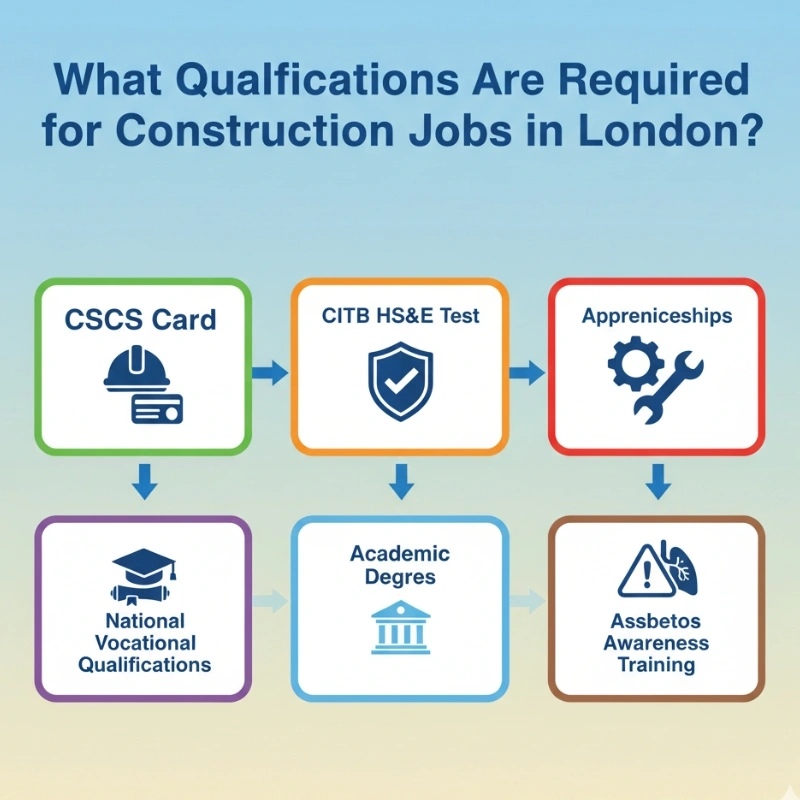
CSCS Card
The Construction Skills Certification Scheme (CSCS) Card is the most recognised qualification across the UK construction industry. It shows you know site safety and basic training. To get a basic Green CSCS card, workers must pass the Level 1 Award in Health and Safety in a Construction Environment and the CITB HS&E test. This card lets you work on most building sites.
CITB Health, Safety and Environment (HS&E) Test
Passing the CITB HS&E test is a prerequisite to get a CSCS card. It assesses awareness of hazards, Personal Protective Equipment (PPE), and safe work practices. The test ensures every worker helps maintain a secure work environment.
Apprenticeships in Construction
Apprenticeships mix on-the-job training with classroom learning. They prepare you for trades such as carpentry, bricklaying, or plumbing. Applicants must be over 16, live in England, and usually have GCSEs in English and Maths. Apprenticeships have four levels:
- Intermediate (Level 2): Equal to GCSEs.
- Advanced (Level 3): Equal to A-levels.
- Higher (Levels 4–5): Equal to a foundation degree.
- Degree (Levels 6–7): Equal to a bachelor’s or master’s degree.
Apprenticeships pay you while learning. They also lead to recognised standards.
National Vocational Qualifications (NVQs)
NVQs are work-based awards that assess your ability to perform tasks to industry standards. They are essential for advancing your career.
- NVQ Level 2 – entry-level trades (bricklayer, painter).
- NVQ Level 3–4 – advanced craft or supervisory.
- NVQ Level 5–7 – management and senior roles.
Site Supervisor Safety Training Scheme (SSSTS)
The SSSTS course prepares workers for a supervisory role. It teaches on-site health and safety management and gives a recognised certificate needed for first-line supervision.
Site Management Safety Training Scheme (SMSTS)
The SMSTS course targets site managers, project managers, and senior supervisors. It covers health and safety legislation, risk assessments, and leadership duties required to run large London projects.
Academic Degrees
Some construction jobs need a degree. Civil engineers, architects, and quantity surveyors often hold a Bachelor of Science in Civil Engineering, Structural Engineering, or Construction Management.
Employers and professional bodies such as the Chartered Institute of Building (CIOB) and the Institution of Civil Engineers (ICE) expect advanced study. Knowledge of Building Information Modelling (BIM) adds value for design and management roles.
NPORS (National Plant Operators Registration Scheme)
NPORS validates skills in plant operations. Similar to the CPCS, it shows competence in handling machinery and is widely accepted across the UK.
ECS (Electrotechnical Certification Scheme)
The ECS card is required for electrical work on construction sites in London. It verifies electrical training, trade qualifications, and safety awareness for UK projects.
Asbestos Awareness Training
Asbestos awareness is legally required for many construction jobs in London. The Category A Asbestos Awareness course teaches workers to identify Asbestos-Containing Materials (ACMs) and apply risk management to prevent exposure.
CPCS (Construction Plant Competency Scheme)
The CPCS confirms skills in operating heavy machinery such as cranes, industrial forklifts, or telescopic handlers. This qualification proves competence and legal compliance for plant operators across London construction sites.
What Career Opportunities Exist in Construction Jobs in London
Construction jobs in London provide clear career paths, from entry-level trade roles to senior management and specialist positions. The industry employs more than 2.1 million people in the UK (Office for National Statistics, 2024: https://www.ons.gov.uk/) and continues to expand with housing, transport, and commercial projects. Workers can start on-site and progress into higher-paid technical or managerial roles through training and certification.
Trade Roles with Strong Demand
Bricklaying, carpentry, and plumbing form the backbone of the construction sector in London. These roles are well-paid and suit people who enjoy practical, hands-on tasks.
- Bricklayers – Average earnings range between £160–£200 per day. This role offers steady demand across housing and commercial projects.
- Carpenters and Joiners – Experienced professionals often earn £18–£25 per hour, with work available in residential and commercial builds.
- Plumbers – Those with Gas Safe registration earn similar hourly rates. Plumbing also offers year-round employment due to constant demand for installation and maintenance.
These trade careers also provide a direct path into self-employment once experience is built.
Multi-Skill and Maintenance Jobs
Facilities management and general maintenance jobs are vital for keeping London’s buildings safe and functional. Workers with broad abilities, such as basic plumbing, minor electrical work, and general repairs, are highly valued.
- Average pay ranges from £24,000 to £35,000 per year.
- Certifications such as CSCS or NVQ Level 3 improve career prospects.
- Opportunities are available across offices, schools, hospitals, and transport hubs, ensuring long-term stability.
Site Supervision and Management
Workers can advance to supervisory and management positions with the right training.
- Supervisors – Completing NVQ Level 3 or the Site Supervisor Safety Training Scheme (SSSTS) enables workers to move into first-line supervision roles, with salaries around £35,000 to £45,000 per year.
- Site Managers – With further training, such as the Site Management Safety Training Scheme (SMSTS) or a construction management degree, workers can progress to site or project manager positions. Salaries for managers range from £50,000 to £65,000, and responsibilities include leading teams, managing budgets, and overseeing schedules on large London projects.
Technical and Professional Careers
Higher education opens doors to technical and professional careers in London’s construction sector. These include roles such as quantity surveyors, civil engineers, and architects.
- Entry salaries begin around £30,000 per year.
- Senior professionals often exceed £70,000 annually.
- Professional body memberships, such as with the Chartered Institute of Building (CIOB) or the Institution of Civil Engineers (ICE), are often required.
These careers focus on long-term planning, design, cost control, and safety. Skills in Building Information Modelling (BIM) and CAD software also improve employability and career growth.
Specialist Plant and Electrical Roles
Specialist roles focus on machinery operation and electrical systems, both of which are essential on London sites.
- Machine Operators – With a CPCS or NPORS card, workers can run cranes, forklifts, or excavators. Pay ranges from £17–£25 per hour, depending on the machine type.
- Electricians – Workers with an ECS card can specialise in areas like power systems, renewable energy, or smart building technology. Average salaries fall between £35,000 and £45,000 per year, with contractors often earning more.
How to Start and Progress in a Construction Career in London
A construction career in London starts with training and grows with steady practice. You need cards, courses, and site time to move into better roles. Follow these steps to begin and progress.
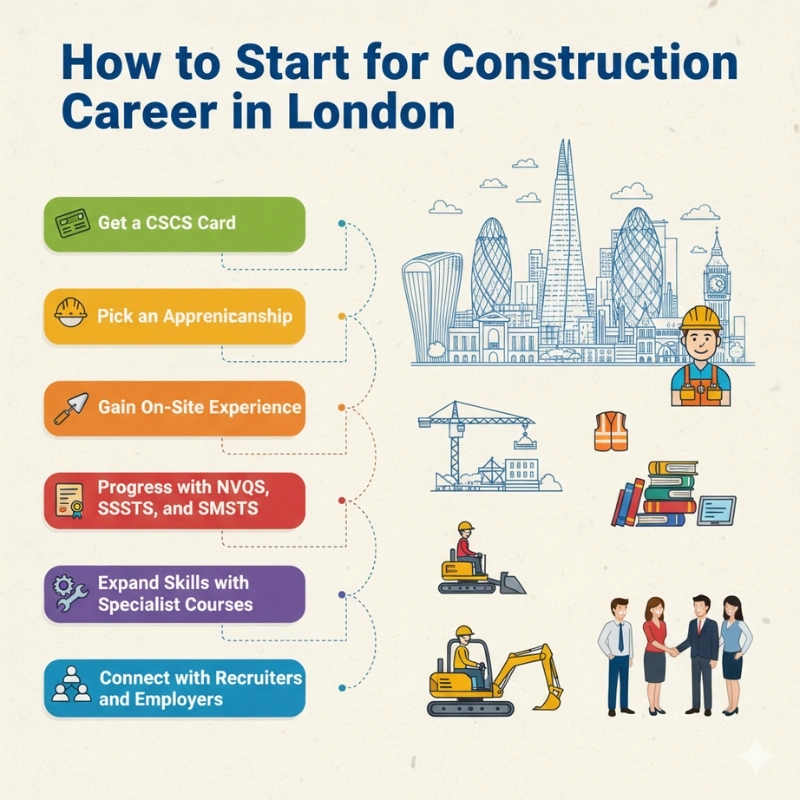
1. Get a CSCS Card
You cannot work on most sites without a CSCS card. First, pass the CITB Health, Safety and Environment test. Then apply online for your card. It proves you know site safety and lets you start work.
2. Pick an Apprenticeship or Entry-Level Role
An apprenticeship is the best way to learn and earn at the same time. The CITB approves many options.
- Level 2: trade skills like bricklaying or carpentry.
- Level 3: advanced trades or technical skills.
Apprentices get pay, site training, and NVQ qualifications.
3. Gain On-Site Experience
Working on real projects builds your skills fast. London has housing sites, rail upgrades, and tall office towers. Show up on time, follow rules, and stay safe. Good work habits help you get longer contracts.
4. Progress with NVQs, SSSTS, and SMSTS
Once you have experience, aim for NVQs.
- Level 3 NVQ: helps you move into site supervisor roles.
- Level 6 NVQ: prepares you for site management.
Add SSSTS or SMSTS training to meet safety laws and step into leadership jobs.
5. Expand Skills with Specialist Courses
Take extra courses to boost your career.
- CPCS card: run plant machines like cranes or forklifts.
- ECS card: work in electrical trades.
Learning BIM, CAD, or green methods raises your pay and job options.
6. Connect with Recruiters and Employers
Sign up with recruitment agencies and visit job fairs. Keep your CV, cards, and references up to date. Stay in touch with recruiters to find regular site work.
A career in construction grows when you earn cards early, train often, and prove you are reliable.
Final Thoughts
A career in London’s construction industry begins with the right skills and training. Employers want people who are hardworking and reliable. They also value physical endurance, strong communication, and safety awareness. A CSCS Card and a health and safety test certify your skills and greatly enhance your prospects.
Across all construction sectors, from planning and building to maintaining and demolishing, there are thriving careers waiting for you.
Frequently Asked Questions (FAQs)
Q: What qualifications do you need to be a construction worker in the UK?
A: Many entry-level roles need no formal qualifications, but a CSCS Card and a passed health and safety test are essential. For specialist jobs, NVQs, diplomas, or apprenticeships in trades such as bricklaying, plumbing, or electrical work are valuable.
Q: How much do construction workers get paid in London?
A: Pay in London is higher than the UK average. General labourers often earn between £12–£16 per hour, while skilled tradespeople such as electricians, plumbers, and bricklayers can earn £20–£30 per hour or more, depending on experience and demand.
Q: How can I get into construction in the UK with no experience?
A: You can start with entry-level labouring roles that do not require prior experience. Many employers provide on-the-job training. Gaining a CSCS Card is the best first step, and from there, you can progress through apprenticeships or NVQs.
Q: What’s the easiest construction job?
A: Labouring roles are often seen as the easiest to start with since they require fewer qualifications. Tasks include moving materials, cleaning sites, and assisting trades. These jobs help you gain experience and can lead to more skilled positions.
Q: Are construction jobs in demand in the UK?
A: Yes. Demand is high across housing, transport, and commercial projects. Skilled workers such as electricians, plumbers, and carpenters are especially sought after, and general labourers are also needed to support major building projects.
Q: What is the difference between NVQs and apprenticeships?
A: NVQs (National Vocational Qualifications) assess your skills while you work, proving you are competent in your trade. Apprenticeships combine paid work with structured training and study, leading to both experience and recognised qualifications.