


How to Choose the Right Labour Hire Service Provider in the UK
To choose a labour hire service provider, work through 9 checks. They cover licences and memberships, insurance cover, worker screening, industry experience, types of provider, speed of supply, charge rates and fees, communication and account management, and warning signs.
A labour hire service provider supplies temporary and temp-to-perm agency workers to a hirer and manages pay, Right to Work checks and compliance. Temporary workers are charged at an hourly rate (pay, employer costs and margin), and permanent placements usually cost a percentage of first-year salary. Skill level, contract length, shift pattern, headcount, sector risk and payment terms set the rate.
Check each provider’s licence where the sector requires one, then compare providers on verified evidence. Request documents, references and itemised quotes to counter missing licences, hidden fees and slow replies.
1. Verify Licences and Memberships
To verify a labour hire provider’s licences and memberships, check 5 credentials.
5 credentials to check in a labour hire provider are listed below.
- Check Companies House registration, including director history and filing dates, for every labour hire provider on the shortlist.
- Confirm a Fair Work Agency licence where work involves agriculture, horticulture, shellfish gathering, or food and drink processing and packaging.
- Verify Association of Labour Providers (ALP) membership in the ALP Member Directory, which lists full members only, not Provisional Members.
- Request the licence number and a copy of the certificate, then check both against the issuing body’s records.
- Review compliance with the Employment Agencies Act 1973 and ask the labour hire provider to name the standards followed.
The Fair Work Agency has issued gangmaster’s licences since 7 April 2026, taking over from the Gangmasters and Labour Abuse Authority.

2. Confirm Insurance Cover
To confirm a labour hire provider’s insurance cover, check 4 insurance documents.
4 insurance documents to request from a labour hire provider are listed below.
- Request the employers’ liability certificate, which shows cover of at least £5 million from an authorised insurer.
- Obtain the public liability certificate, which covers injury to third parties and damage to their property caused by agency workers.
- Ask for professional indemnity cover, which responds to claims of negligence in the labour hire provider’s advice or placements.
- Compare policy dates, cover limits and insurer names across all 3 certificates to find gaps or expired policies.
Employers’ liability insurance is compulsory, with fines of £2,500 for each day without cover and £1,000 for failing to display the certificate.
3. Check Worker Screening Methods
To check a labour hire provider’s worker screening, review 6 vetting steps.
6 vetting steps in worker screening are given below.
- Complete Right to Work checks before the first shift and store dated evidence for every agency worker.
- Verify identity and address using original documents, and compare each photograph with the person attending the interview.
- Collect references covering the last 3 to 5 years of employment history, and record the referee’s name and date.
- Match each role to a DBS check level: Basic for any role, Standard or Enhanced only where law allows.
- Assess practical skills through a test or supervised trial shift for skilled roles such as forklift operation.
- Record training certificates, inductions and expiry dates in one central file for every agency worker.
Only employers based in England or Wales can apply for Standard or Enhanced DBS checks, and applying for an ineligible role breaks the law.

4. Match Industry Experience to the Sector
To match industry experience to the sector, compare 5 evidence points.
5 evidence points of industry experience are listed below.
- Count the years of trading and the number of clients supplied in the same sector, such as warehousing or logistics.
- Check sector tickets, including Construction Skills Certification Scheme (CSCS) cards and Road Transport Industry Training Board (RTITB) forklift training.
- Review case studies from manufacturing, warehousing or logistics clients with comparable headcount and shift patterns.
- Request references from 2 current clients in the same sector and ask about attendance, punctuality and safety record.
- Contrast specialist and generalist agencies on candidate pool depth in the required roles and on market knowledge.
Sector evidence shows whether a labour hire provider has supplied workers for comparable operations.
5. Compare Types of Labour Hire Service Providers
The different types of labour hire service providers are temporary, temp-to-perm, permanent, sector-specialist and managed service providers.
Types of labour hire service providers by contract and sector are listed below.
- Temporary providers supply agency workers for fixed periods, covering absence, seasonal peaks and short projects.
- Temp-to-perm providers place agency workers on trial, then transfer the worker to the hirer’s payroll after a set period.
- Permanent recruitment providers find candidates for direct employment and charge a fee, usually a percentage of first-year salary.
- Sector-specialist providers focus on one industry, such as warehousing or manufacturing, and hold a matching pool of ticketed workers.
- Managed service providers run the full contingent workforce programme for a hirer, including supplier management, reporting and invoicing.
Contract type and sector focus separate the 5 types of labour hire service providers.
6. Test Speed of Supply
To test a labour hire provider’s speed of supply, measure 5 response points.
5 response points of a labour hire provider are given below.
- Time the gap between a staffing request and a confirmed worker list, in hours or working days.
- Ask for the fastest and average fill times for orders of 10 or more workers.
- Confirm night shift, weekend and same-day cover, including the number of workers available at short notice.
- Request a seasonal peak plan stating how many extra workers the labour hire provider supplies and the notice period required.
- Compare worker retention rates and trial shift attendance, as high retention reduces onboarding cost and absence.
Measured response times show how a labour hire provider performs when demand rises at short notice.

7. Break Down Charge Rates and Fees
To break down a labour hire provider’s charge rate, itemise 6 cost lines.
A charge rate equals the worker’s pay rate plus employer costs plus the provider’s margin. For illustration, a £13.00 hourly pay rate, £3.50 of employer costs and a £2.50 margin give a £19.00 charge rate. Hidden fees raise the final budget, whereas an itemised rate makes comparison between providers simple.
6 cost lines in a labour hire charge rate are listed below.
- List the worker’s hourly pay rate and confirm that the rate meets the statutory minimum wage for the worker’s age.
- Add employer costs, including employer National Insurance, holiday pay and pension contributions, as separate lines.
- Identify the provider’s margin as a percentage of the total charge rate rather than as a hidden uplift.
- Clarify overtime, night shift and bank holiday multipliers in writing before the first shift is worked.
- Question any extra fees, such as onboarding, uniform, transport or timesheet charges, and ask for each fee in the quote.
- Read the replacement policy and notice period in the contract, noting any fee for ending an assignment early.
An itemised charge rate, checked against the Association of Labour Providers’ Charge Rate Guidance, lets a business compare the true cost of labour across providers.
Identify Factors That Determine Labour Hire Charge Rates
To identify the factors that determine labour hire charge rates, review 6 pricing drivers.
Factors that determine labour hire charge rates are given below.
- Worker skill level: ticketed or qualified workers, such as forklift drivers, command higher pay rates than general operatives.
- Contract length: longer assignments give providers more predictable income, which affects the hourly margin quoted.
- Shift pattern: night, weekend and split shifts carry premium pay and raise the total charge rate.
- Headcount: orders of 10 or more workers raise recruitment, onboarding and supervision effort for the labour hire provider.
- Sector risk: manual, high-risk work, such as construction or logistics, raises insurance and safety-training costs.
- Payment terms: shorter invoice terms, such as 7 days, reduce the provider’s funding cost and the margin quoted.
These 6 factors explain why charge rates for the same role differ between labour hire providers.
8. Assess Communication and Account Management
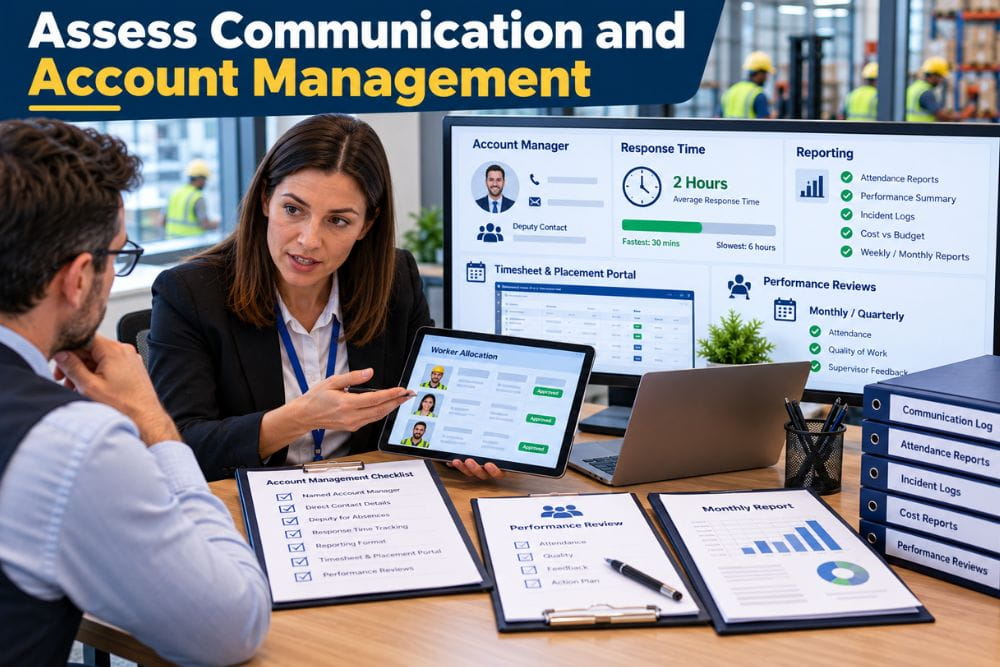
To assess a labour hire provider’s communication, examine 5 service standards.
5 service standards of a labour hire provider are listed below.
- Identify a named account manager with a direct telephone number, email address and a deputy for absences.
- Measure response time to queries, in hours, during a trial period, and record the slowest reply.
- Review the reporting format, covering attendance, performance, incident logs and cost against budget, and note the reporting frequency.
- Inspect the timesheet and placement portal for approval speed, invoice clarity and the ability to review upcoming allocations.
- Schedule performance reviews monthly or quarterly, with an agreed agenda covering attendance, quality and feedback from supervisors.
Consistent communication standards show how a labour hire provider handles issues after placement.
9. Spot Warning Signs
To spot a poor labour hire provider, look for 6 warning signs.
6 warning signs of a poor labour hire provider are given below.
- Notice reluctance to share a licence number, or a missing Fair Work Agency licence where required, a compliance risk.
- Detect evasive answers about Right to Work checks and screening, a compliance risk that exposes the hirer to penalties.
- Observe pressure to sign a contract before a full cost breakdown arrives, a cost and service risk.
- Find hidden fees or charge rates that differ between quotes for the same role, a cost risk.
- Flag missing insurance certificates or expired policy dates, a compliance risk that leaves injury and damage claims uncovered.
- Record slow responses to enquiries, such as replies taking more than 2 working days, a service risk.
Warning signs point to compliance, cost and service risks, including worker exploitation and tax evasion.
Final Thoughts
To choose the right labour hire service provider, verify licences, insurance and worker screening first, then compare industry experience, speed of supply and itemised charge rates. Test communication during a trial period and treat any warning sign as a reason to pause. Rank providers on documents, references and measured response times rather than promises. The provider that proves compliance, quotes transparently and replies quickly is the safest choice for your business.
Frequently Asked Questions
Q: What is a labour hire agency?
A: A labour hire agency is a recruitment agency that supplies agency workers to a hirer for temporary, temp-to-perm or volume needs. The agency pays the workers and manages Right to Work checks and compliance, and the hirer pays the agency a charge rate for each hour worked.
Q: Is using a labour hire provider better than recruiting workers directly?
A: A labour hire provider is better for short-term, seasonal or urgent needs, because it handles recruitment, payroll and compliance checks. Direct recruitment suits long-term roles where the business wants full control over selection and employment terms. Compare the total cost of each route, including management time.
Q: Is it better to use a specialist or generalist labour hire provider?
A: A specialist provider is better for ticketed or skilled roles, such as forklift driving or construction work, because it holds a matching pool of workers. A generalist provider suits mixed or general operative roles across several sites. Ask each provider for sector references and fill times for your roles.
Q: How does a hirer hire a labourer through a labour hire provider?
A: To hire a labourer through a labour hire provider, follow 4 steps:
- Record the number of labourers, required skills and tickets, assignment length and shift pattern
- Request itemised quotes from 2 to 3 providers for the same brief
- Verify licences, insurance certificates and worker screening for each provider
- Run a trial placement and track attendance and quality before a larger order
Q: Which registers list a registered labour hire provider?
A: Registration of a labour hire provider sits in 3 separate records:
- Companies House confirms the company exists, with director history and filing dates
- The Fair Work Agency issues the gangmaster’s licence for agriculture, horticulture, shellfish gathering, and food and drink processing and packaging
- The Association of Labour Providers (ALP) Member Directory lists full members only
Check each record separately and match the licence number to the issuing body. Also request current insurance certificates and references from two current clients in the same sector.
Q: How does a labour hire provider screen workers?
A: A labour hire provider screens workers in 6 steps: Right to Work checks, identity and address verification, references, a role-based DBS check where the law allows, a skills test or trial shift for skilled roles, and a record of training certificates. Ask to see dated evidence for each step.
Q: What happens if an agency worker does not turn up?
A: The provider should replace the worker, usually under the replacement policy in the contract. Report the absence to the account manager as soon as it happens, request cover and keep a record of each no-show. Compare no-show rates across providers before signing.
Q: What happens if a labour hire provider sends an unsuitable worker?
A: The hirer reports the issue to the provider, which then replaces the worker or ends the assignment, as the contract states. Check the replacement policy, the notice period and any fee for ending an assignment early before signing. Record the reason and the date in writing.
Q: Can an agency worker become a permanent employee?
A: Yes. An agency worker can become a permanent employee through a temp-to-perm arrangement, where the worker transfers to the hirer’s payroll after a set period. Confirm the transfer terms in the contract before the first assignment, including any fee and the point at which it applies.
Q: What fees apply when hiring an agency worker permanently?
A: A transfer fee may apply when a hirer takes on an agency worker directly. The fee and its qualifying period must be set out in the provider’s terms, so ask for both in writing. Some providers reduce the fee the longer the worker has been on assignment.