


High Paying Railway Jobs in the UK: Salaries, Roles and How to Get In (2026)
The UK rail industry pays well above the national average, and for the right roles, significantly above it. Senior signalling engineers regularly earn £85,000 or more. Experienced train drivers on the East Coast Main Line take home over £70,000. Rail project managers on major works clear £90,000. Across the sector, the median salary sits at around £47,000, against a UK full-time average of £37,430.
The 10 highest paying roles are train driver, signalling engineer, rail project manager, rail systems engineer, OHL/electrification engineer, rail civil engineer, rolling stock engineer, railway signaller, COSS/track maintenance engineer, and rail operations manager. Each section below covers what the role pays, what it involves, and how to get in. You’ll also find average salaries by city, driver pay by operator, entry-level pay, benefits beyond base salary, including the Railway Pension Scheme, and clear entry routes from any background.
Which Railway Job Pays the Most in the UK?
Senior rail project managers and principal signalling engineers sit at the top of the UK railway pay scale. Both regularly exceed £90,000 on major infrastructure contracts, with some senior project director roles reaching £120,000 on programmes such as Crossrail 2 or HS2. At the frontline, experienced train drivers on premium routes, particularly Eurostar and London Underground, earn £72,000 to £80,000 when shift premiums are included.
Executive roles sit in a different bracket altogether. The CEO of Network Rail earns close to £600,000 per year, and eight of the ten highest-paid civil servants in the UK work in rail. For the purposes of this guide, the focus is on roles accessible through standard career paths, not board-level appointments.
What Are the Average Railway Salaries in the UK in 2026?
Ranges reflect typical permanent, PAYE roles. Contract day-rates for senior engineers and project managers can exceed £600/day. London weighting adds 10–20% to most figures above.
Rail salaries vary widely by role, specialism, and location. Senior engineers and project managers command the strongest packages, while entry-level and operational roles offer solid starting points with clear routes upward. London weighting adds 10–20% to most figures, and contract day-rates for experienced engineers regularly exceed £600.
The table below summarises typical salary ranges across the main rail roles.
| Role | Typical Salary Range |
|---|---|
| Railway Engineer (general) | £42,000 – £85,000+ |
| Train Driver | £48,000 – £72,000+ |
| Signalling Engineer | £52,000 – £85,000+ |
| Rail Project Manager | £55,000 – £90,000+ |
| Rail Systems Engineer | £48,000 – £78,000 |
| OHL / Electrification Engineer | £45,000 – £75,000 |
| Rail Civil Engineer | £42,000 – £68,000 |
| Rolling Stock Engineer | £40,000 – £68,000 |
| Railway Signaller | £34,000 – £58,000 |
| COSS / Track Engineer | £32,000 – £55,000 |
| Rail Operations Manager | £46,000 – £80,000 |
| Quantity Surveyor (Rail) | £38,000 – £58,000 |
| Station Manager | £35,000 – £58,000 |
| Railway Worker (entry-level) | £24,000 – £34,000 |
What Are the Top 10 High Paying Railway Jobs in the UK?
The 10 railway roles below represent the strongest combination of salary, long-term demand, and career progression in the UK rail sector. Each entry covers what the role involves, what it pays, and how to get into it.
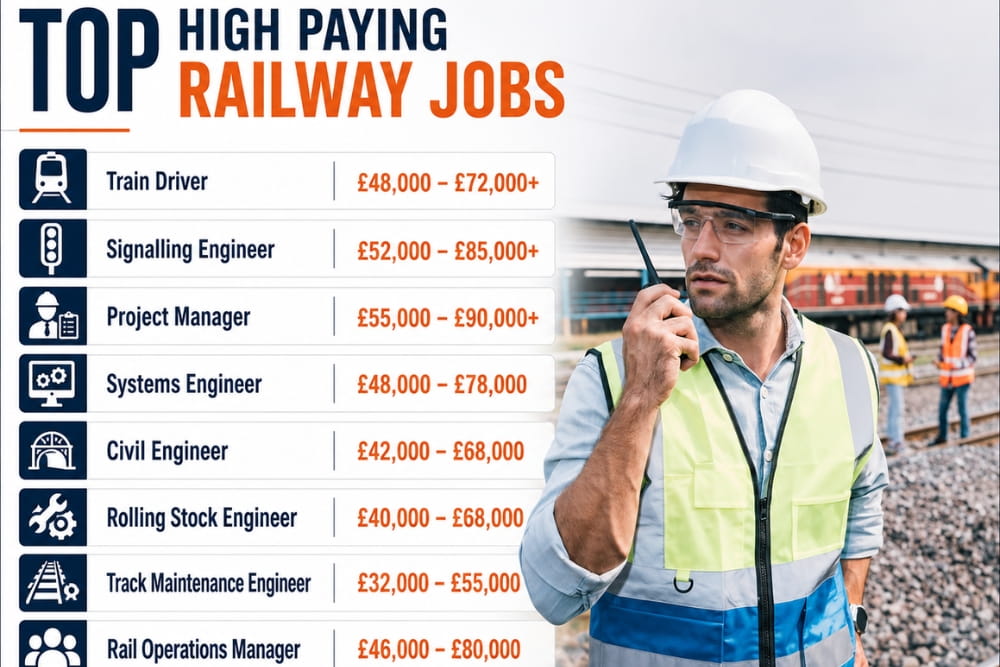
1. Train Driver
£48,000 – £72,000+
Train drivers operate passenger and freight services, following strict signalling rules and timetables while bearing full responsibility for onboard safety. The role demands sustained concentration, regular medical assessments, and psychometric testing, all of which filter out many candidates before training starts.
- Salary: £48,000 – £72,000+ per year. London Underground drivers earn at the higher end; regional and freight operators pay less. Shift premiums for nights and weekends add £4,000 – £8,000 above basic pay.
- How to get in: No degree required. Candidates must pass spatial reasoning, concentration, and reaction-time tests, plus a Group 2 medical, including colour vision and hearing checks. Trainee programmes last 12–18 months and are fully paid.
- Career progression: Senior driver → driver trainer → traction inspector → depot manager.
2. Signalling Engineer
£52,000 – £85,000+
Signalling engineers design, test, and maintain the electronic and mechanical systems that direct train movements across the network. Errors in signalling design carry severe consequences, which is why pay reflects the level of responsibility attached to every decision made in this role. Job adverts sometimes use the broader title “railway engineer” for this position, so check the job description for signalling-specific duties before assuming pay levels transfer directly.
- Salary: £52,000 – £85,000+ per year. Principal engineers on ETCS projects regularly exceed £90,000. Contract rates reach £500 – £700 per day.
- How to get in: A degree in electrical, electronic, or systems engineering is the standard route. The IRSE licence is increasingly expected for senior positions. Graduate schemes with Network Rail, Siemens Rail, Alstom, or Atkins offer structured entry.
- Career progression: Lead engineer → principal engineer → technical director → IRSE-registered professional.
3. Rail Project Manager
£55,000 – £90,000+
Rail project managers oversee everything from station refurbishments to multi-billion-pound electrification schemes. They control budgets, manage contractors, resolve regulatory issues, and report to senior stakeholders, all in an industry where a single day’s overrun on a possession can cost hundreds of thousands of pounds.
- Salary: £55,000 – £90,000+ per year for permanent roles. Contract project managers on large infrastructure schemes earn £450 – £650 per day.
- How to get in: Most enter through engineering backgrounds and progress via APM, PRINCE2, or PMP qualifications. Network Rail’s project management graduate scheme offers a direct route.
- Career progression: Senior project manager → programme manager → project director → head of delivery.
4. Rail Systems Engineer
£48,000 – £78,000
Rail systems engineers integrate signalling, power, rolling stock, communications, and civil infrastructure to keep the network functioning as one cohesive system. Demand is highest on major programmes where multiple contractors must deliver interconnected technical outputs to a shared safety standard and single operational deadline. This role often appears in job adverts simply as “railway engineer” or “train engineer,” even though it covers systems work rather than driving or maintaining a single train.
- Salary: £48,000 – £78,000 per year, rising above £90,000 at principal and chief engineer level.
- How to get in: An engineering degree and Chartered Engineer (CEng) status through IMechE or IET are the standard credentials. Experience in safety assurance or RAM (Reliability, Availability, and Maintainability) analysis strengthens applications considerably.
5. Electrification and Overhead Line Engineer
£45,000 – £75,000
Electrification engineers, commonly called OHL engineers, design, install, and maintain the electrical systems that power trains. As the UK pushes forward with removing diesel traction from the network, demand for this specialism has grown sharply and shows no sign of easing.
- Salary: £45,000 – £75,000 per year for permanent roles. Skilled OHL contractors earn £350 – £550 per day.
- How to get in: A background in electrical engineering or high-voltage systems is the most direct route. Network Rail, Colas Rail, and BAM Nuttall run OHL training programmes. IET membership and HV authorisations increase earning potential.
6. Rail Civil Engineer
£42,000 – £68,000
Rail civil engineers maintain and design physical infrastructure — bridges, tunnels, embankments, drainage systems, and track foundations. Work ranges from routine asset inspections to complex geotechnical investigations following ground movement or flooding events, often under tight access windows and strict safety controls. This is another role that recruiters list under the general “railway engineer” heading, so confirm whether an advert means civil, systems, or signalling work before comparing pay.
- Salary: £42,000 – £68,000 per year. Senior civil engineers with ICE Chartered status earn £70,000 – £85,000 on major projects.
- How to get in: A BEng or MEng accredited by the Institution of Civil Engineers is the standard entry route. Graduate schemes with Network Rail, Atkins, WSP, or Mott MacDonald provide structured progression towards CEng status.
7. Rolling Stock Engineer
£40,000 – £68,000
Rolling stock engineers keep trains mechanically and electrically fit for service, covering routine maintenance, fault diagnosis, and new fleet commissioning. Engineers at Derby-based manufacturers such as Alstom and Hitachi Rail work across the full product lifecycle from build through to long-term in-service support.
- Salary: £40,000 – £68,000 per year. ONS ASHE 2024 data records a median of £56,984 for rail and rolling stock builders and repairers, the third highest median of any UK occupation.
- How to get in: Level 3 mechanical or electrical engineering qualifications are the entry point. Apprenticeships with manufacturers or depot operators, followed by HNC/HND study, support progression. IMechE membership strengthens routes to senior roles.
8. Railway Signaller
£34,000 – £58,000
Signallers control train movements from signal boxes and electronic control centres. They authorise movements, manage possessions — planned windows when track comes out of service for maintenance — and respond immediately when anything goes wrong across their section of the network.
- Salary: Network Rail pays signallers £34,600 – £57,200 across Grades 2 to 10, with higher grades reflecting route complexity. London and South East signallers receive a regional allowance on top of grade pay.
- How to get in: No formal qualifications required. Network Rail recruits and trains fully in-house. Selection includes aptitude tests and a competency interview. Training takes 12–18 months with pay continuing throughout.
- Career progression: Senior signaller → shift signaller manager → control room manager → operations manager.
9. COSS / Track Maintenance Engineer
£32,000 – £55,000
A Controller of Site Safety (COSS) holds legal responsibility for worker safety during trackside maintenance and engineering works. Every work team requires a qualified COSS on site, making this one of the most consistently in-demand qualifications across the rail contracting sector. Track maintenance engineers inspect, repair, and renew rails, sleepers, ballast, and fittings.
- Salary: £32,000 – £55,000 per year for employed roles. COSS-qualified contractors earn £200 – £350 per day, with additional qualifications such as Lookout or IWA pushing rates higher.
- How to get in: A Personal Track Safety (PTS) card, obtained in two to five days, is the prerequisite. COSS qualification follows after roughly six months of trackside experience. Both are administered through the Sentinel scheme.
10. Rail Operations Manager
£46,000 – £80,000
Rail operations managers run day-to-day service performance, coordinating drivers, train managers, station staff, and control teams. They manage disruption, hit performance targets, and carry real commercial weight — train performance penalties under operator agreements mean a poorly run operations function directly affects the bottom line. This differs from a train manager, who works on board trains handling passengers and revenue rather than running the wider operation — see the FAQ below for the full distinction.
- Salary: £46,000 – £80,000 per year. Senior operations directors at large TOCs reach £90,000 – £120,000.
- How to get in: Most rise through frontline roles — train manager, station manager, or control room before moving into management. A degree is not essential, but a Diploma in Transport Management or a Rail Business qualification strengthens promotion prospects.
How Much Does a Railway Surveyor Earn?
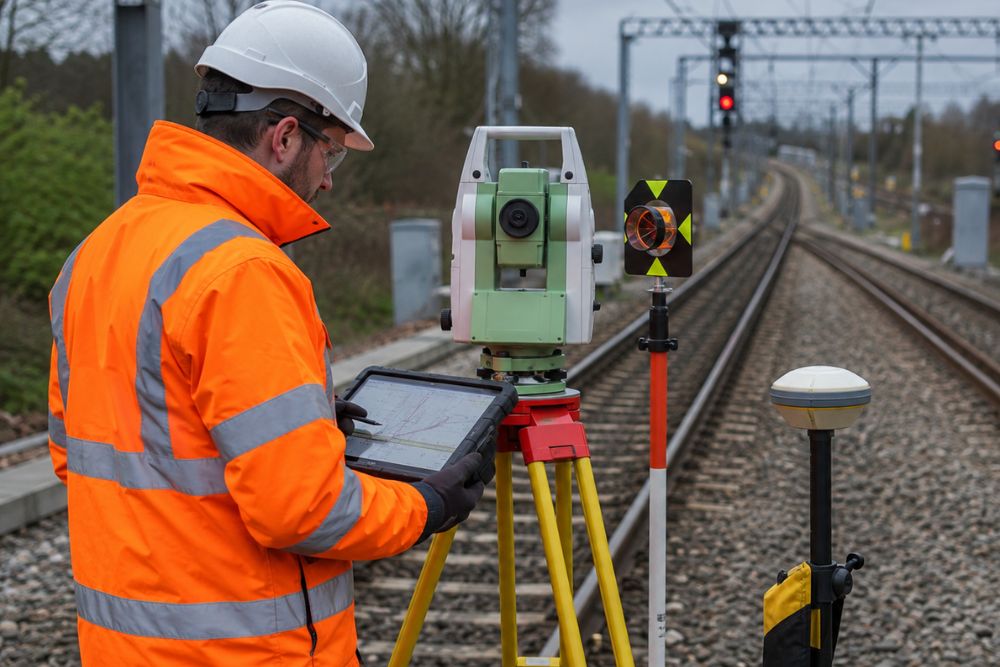
Railway surveyors measure and record track geometry, structure gauging, and land boundaries to support renewals, upgrades, and new-build projects. The work combines fieldwork often trackside, during possessions with data processing back at the office.
Quantity surveyors in rail, who cost and value construction work rather than measure the physical asset, typically earn £38,000 to £58,000 a year, rising above £65,000 for chartered RICS members on major infrastructure contracts. Engineering surveyors doing gauging and topographical work sit in a similar band. Entry usually comes through a geomatics, civil engineering, or quantity surveying degree, though some contractors take on trainees with a Level 3 surveying qualification and build up RICS chartership on the job.
What Does an Entry-Level Railway Worker Earn?
Not every rail role requires an engineering degree or a specialist qualification. Roles such as track operative, platform assistant, and station host sit at the entry point of the industry and typically pay £24,000 to £34,000 a year, according to Network Rail and train operating company job listings. Conductors and on-board staff often start in a similar range, with pay rising as they move into train manager or supervisory positions.
These roles suit school leavers and career changers with no prior rail experience. Most require only a Personal Track Safety (PTS) card for trackside work, or in-house customer service training for station and on-board roles both fully funded by the employer, with training lasting a few days to a few weeks rather than months. From here, progression typically runs through senior operative, team leader, or driver training programmes, all covered elsewhere in this guide.
How Much Do Train Drivers Earn at Each UK Operator?
Driver pay varies considerably between train operating companies. The differences reflect route complexity, union agreements, shift patterns, and the commercial pressure each operator faces. The figures below are approximate qualified driver salaries, excluding overtime and shift premiums.
| Train Operating Company | Qualified Driver Salary (approx.) | Notes |
|---|---|---|
| Eurostar | £75,000 – £80,000 | Highest in the UK; Channel Tunnel routes |
| London Underground | £60,000 – £72,000 | TfL-employed; strong union rates |
| LNER | £63,000 – £71,000 | East Coast Main Line |
| Avanti West Coast | £61,000 – £68,000 | West Coast routes |
| Greater Anglia | £58,000 – £65,000 | East Anglia network |
| Great Western Railway | £57,000 – £64,000 | Brunel routes; GWR franchise |
| Freightliner | £55,000 – £62,000 | Freight specialist |
| Southern / Thameslink | £54,000 – £61,000 | South-East commuter routes |
| ScotRail | £50,000 – £58,000 | Scotland-wide; publicly owned |
| Transport for Wales | £48,000 – £55,000 | Welsh Government franchise |
How Do Railway Salaries Differ Across UK Cities?
Location affects pay significantly across all rail roles, not just driving. Cities with major engineering hubs, infrastructure projects, or high rail traffic density tend to offer higher base salaries, partly because of demand and partly because of London weighting and regional cost-of-living adjustments.
| City / Region | Average Railway Salary | Key Drivers |
|---|---|---|
| London (Central) | £65,000 – £70,000 | TfL, Crossrail, Eurostar, HS2 hubs |
| Birmingham | £55,000 – £65,000 | HS2 construction, rail engineering cluster |
| Derby | £52,000 – £60,000 | Rolling stock manufacturing, Alstom, Bombardier |
| Bristol | £48,000 – £58,000 | GWR headquarters, cross-country routes |
| Leeds | £46,000 – £54,000 | Northern Powerhouse Rail planning, Network Rail offices |
| York | £44,000 – £52,000 | Network Rail national offices |
| Edinburgh | £43,000 – £50,000 | ScotRail HQ, Borders Railway |
| Glasgow | £40,000 – £48,000 | ScotRail, Caledonian Sleeper |
| Manchester | £38,000 – £46,000 | Northern Rail, Avanti; lower seniority mix |
What Benefits Do Railway Workers Receive Beyond Their Salary?
Base salary is only part of what makes rail careers financially rewarding. The full compensation package across most permanent rail roles includes benefits that workers in comparable private-sector jobs rarely receive.
| Benefit | Detail |
|---|---|
| Railway Pension Scheme (RPS) | Defined-benefit pension — one of the few remaining in the private sector. Employer contributions typically 16–22%. |
| Free staff travel pass | Most TOCs give permanent staff a free travel pass covering the national rail network. Many extend this to the immediate family. |
| Friends & family tickets | Heavily discounted leisure travel (up to 75% off) for family members and nominated friends. |
| Shift premiums | Night shifts, weekend working, and bank holidays attract premiums of 25–50% on top of basic pay. |
| Funded training | All licensing, safety certifications, and PTS/COSS qualifications are paid for by the employer. |
| Structured career progression | Most Network Rail and TOC roles have clear banding systems with annual progression steps. |
What Is the Railway Pension Scheme and Why Does It Matter?
The Railway Pension Scheme (RPS) is a defined-benefit pension, meaning your retirement income is calculated based on your salary and years of service, not the performance of an investment fund. This structure has largely disappeared from the private sector, making it a genuine financial advantage for rail workers.
Most TOC employees and Network Rail staff are enrolled in the RPS from their first day. Employer contributions typically run between 16% and 22% of salary. A train driver contributing to the RPS for 30 years will retire with a significantly higher guaranteed income than a peer in a private-sector role with a defined-contribution pension of the same headline value.
Should Rail Contractors Choose a Day Rate or an Hourly Rate?
In the UK rail industry, contractors are typically paid either a day rate or an hourly rate, depending on the nature of the work. Day rates often suit experienced professionals on predictable projects, offering higher earning potential and simpler invoicing. Hourly rates provide greater protection when shifts overrun and are common among PAYE employees and lower-banded contractors. Typical rates range from £13–£31 per hour or £120–£600 per day, depending on role and experience.
How Do You Get Into a High Paying Railway Role?
There is no single entry point into the rail industry. People arrive from construction, electrical trades, the armed forces, customer service, and straight from school or university. The table below maps the main entry routes to the roles they suit best.
| Route | Best for | Time to qualify |
|---|---|---|
| Apprenticeship | School leavers (16+); no prior experience needed | 2–4 years depending on level |
| Graduate scheme | Degree holders in engineering, IT, finance, or management | 2–3 years structured programme |
| Direct entry (trade background) | Electricians, civil engineers, welders, mechanics | 3–6 months induction + sector certs |
| PTS / COSS certification | Anyone seeking trackside or maintenance roles | 2–5 days per qualification |
| Trainee driver programme | Career changers; no degree required — psychometric testing | 12–18 months training period |
| Specialist rail agency | Experienced workers seeking contract roles quickly | Immediate placement possible |
Is the UK Railway Sector a Good Long-Term Career Choice?
Rail investment in the UK is not a short-term trend. Network Rail’s current Control Period commits £34.6 billion to infrastructure maintenance and improvement through to 2029. The electrification rollout, digital signalling upgrades, and Northern Powerhouse Rail development all create sustained demand for engineers, project managers, and operational specialists well into the 2030s.
For anyone considering a career change, rail offers something increasingly rare: work that pays above the national average, a pension scheme with real long-term value, and job security backed by national infrastructure commitments. The entry bar for many roles is lower than candidates expect, and the pay ceiling is higher than most realise.
Ready to explore your options? Browse current rail vacancies or speak to a specialist rail recruitment adviser to find the right entry point for your background.
Frequently Asked Questions
Q: How much does a railway engineer earn in the UK?
A: It depends which discipline the role covers. Signalling engineers earn £52,000–£85,000+, rail systems engineers £48,000–£78,000, and rail civil engineers £42,000–£68,000. Check the job description for the specific discipline before comparing salaries.
Q: How much does a train engineer earn?
A: In the UK, “train engineer” usually refers to a rail systems or rolling stock engineer, paying £40,000–£78,000 depending on specialism. This differs from US usage, where “train engineer” means the person driving the train the UK equivalent role is train driver, paying £48,000–£72,000+.
Q: How much does a railway worker earn?
A: Entry-level railway workers, including track operatives, platform assistants, and station hosts, typically earn £24,000–£34,000 a year. Pay rises with experience and moves into supervisory or specialist roles.
Q: How much does a railway surveyor earn?
A: Quantity surveyors in rail earn £38,000–£58,000 a year, rising above £65,000 for chartered RICS members on major projects. Engineering surveyors doing track and structure gauging sit in a similar range.
Q: What’s the difference between a railway manager and a rail project manager?
A: A rail project manager runs a specific scheme a station upgrade or electrification programme and typically earns £55,000–£90,000+. A train manager works on board trains, handling passengers, safety, and revenue, and usually progresses from frontline roles before moving into operations management. The two titles are not interchangeable, despite both often being shortened to “railway manager” in casual use.